
Product24 May 2025
SPECTRO Series Colour Sensors Applications in Industries
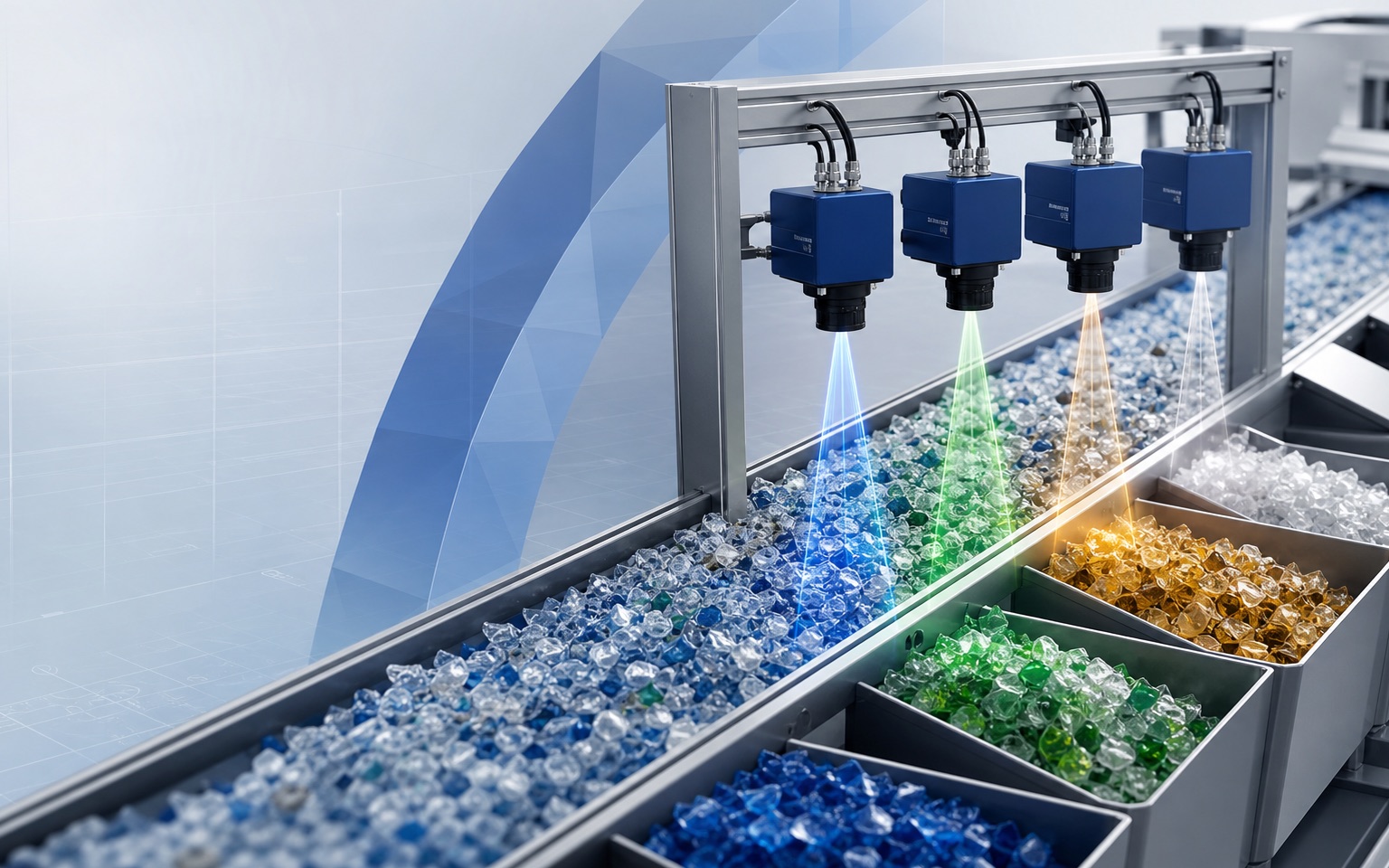
Plastic waste poses a significant environmental challenge, but innovative sensor technologies are paving the way for more efficient and sustainable recycling processes. Color sensors, such as the SPECTRO-3-100-COF-d6.0-CL and SPECTRO-3-28-45°/0°-MSM-ANA-DL, are playing a crucial role in achieving key goals in plastic recycling.
- Enhancing Efficiency and Accuracy in Plastic Sorting
One of the primary challenges in plastic recycling is the need for accurate sorting. Color sensors are addressing this by enabling:
- Identification of lacquered vs. unpainted plastics: This allows for efficient sorting of plastics with different surface treatments.
- Detection and differentiation of colored plastics: High-purity recycling is achieved through the precise separation of plastics by color.
- Uniform color consistency in recycled plastic granules: Ensuring consistent color in recycled materials enhances their quality and applicability.
- Optimization of separation processes in automated recycling plants: Automation is enhanced by the precision of color sensors.
- Reduction of contamination in post-consumer plastic waste: Accurate sorting minimizes impurities in the recycling stream.
- Improving Quality and Sustainability
The use of color sensor technology also contributes to:
- Enhancing the quality of recycled plastic products: Higher purity and consistency lead to better quality recycled materials.
- Enabling real-time quality control in recycling workflows: Continuous monitoring ensures quality throughout the recycling process.
- Improving the sustainability of plastic reuse: By making recycling more efficient and effective, these technologies promote the reuse of plastic materials.
- Reducing reliance on virgin plastic production: Increased recycling reduces the need for new plastic production, conserving resources and energy.
- Applications in Plastic Recycling
The applications of these color sensors in plastic recycling are diverse and impactful:
- Sorting painted vs. non-painted plastic components: This ensures that plastics with different coatings are processed appropriately.
- Separating plastics based on color for reprocessing: Color-based separation allows for the creation of high-quality recycled materials.
- Enhancing quality control in recycled plastic manufacturing: Sensors ensure that recycled plastics meet the required quality standards.
- Reducing waste through precision identification: Accurate identification of plastic types minimizes waste and maximizes recyclability.
- Improving efficiency in plastic sorting automation: Automation is made more effective through the use of sensor technology.
- Ensuring high-purity raw materials for new products: High-purity recycled plastics can be used to create new, high-quality products.
- Enabling AI-driven plastic recognition in smart recycling: These sensors can be integrated into AI-driven systems for even more advanced sorting.
- Minimizing landfill waste with accurate segregation: By improving sorting, these technologies help to reduce the amount of plastic waste sent to landfills.
- Supporting a circular economy with advanced sorting: Efficient sorting is essential for creating a circular economy where plastics are reused and recycled.
- Lowering environmental impact by maximizing recyclability: Overall, these technologies contribute to a more sustainable approach to plastic waste management.
- Specific Examples from Application Notes
The application notes highlight the use of specific SPECTRO-3 series sensors for color differentiation of painted plastic components.
- SPECTRO-3-28-45°/0°-MSM-ANA-DL: This sensor is used for color differentiation of lacquered plastic components at a distance of approximately 28mm.
- SPECTRO-3-100-COF-d6.0-CL: This sensor is used for color differentiation of plastic parts at a distance of approximately 100mm, with a spot size of roughly 6mm in diameter and an angle of the optical axis versus the perpendicular axis of the surface of around 35°.