
Rotary Encoders for Speed and Position Feedback
Incremental and absolute encoders from Kübler (shaft and hollow shaft, optical and magnetic) for motors, drives, cranes, cut-to-length lines and machine axes. Our application engineers help you pick the right one the first time.
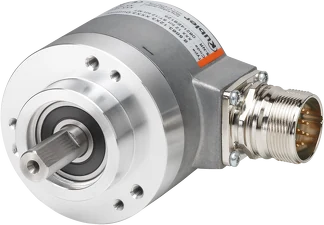
The wrong encoder shows up later as lost position after a power cut, noisy signals on long cable runs, bearings failing on a vibrating shaft, or an interface the drive or PLC can't read.
Types of rotary encoders
Incremental encoders
Output a pulse train (pulses per revolution) for speed and relative position. Simple and economical; the axis is re-referenced after power-up.
Models: KIS40 · KIS50 · KIH40 · KIH50 · 5000 · 5020 · 5026
Singleturn absolute encoders
A unique code for every angle within one revolution, so the position is known immediately at power-up, with no homing run.
Models: Single-turn absolute range · 5852 · 5873 (up to 21-bit)
Multiturn absolute encoders
Also count complete revolutions, so position is kept over many turns without a reference run. Kübler's F-series multiturns work without a gear and are 100% magnetically insensitive.
Models: F3678 · F5863 · F5868 · M3678 · M5863 · M5868
Large hollow-shaft & heavy-duty
Mount directly on large motor or generator shafts, with robust bearings for demanding drives.
Models: A020 (up to Ø42 mm shaft) · H100 · H120 · IH58
What to specify
| Parameter | What to check |
|---|---|
| Incremental or absolute | Must the machine know its position immediately after power-up? Then absolute. For speed or relative movement, incremental is enough. |
| Singleturn or multiturn | If the shaft turns more than once over the travel, choose multiturn to avoid a reference run. |
| Resolution | Work back from the accuracy you need at the load: travel per revolution ÷ required accuracy. Incremental signals can be evaluated 4× (quadrature) in the controller. |
| Shaft or hollow shaft | Solid shaft with a coupling isolates the encoder from shaft run-out; hollow shaft mounts directly on the motor or spindle and saves space. |
| Interface | Match what your drive or PLC reads, e.g. TTL/RS422, HTL push-pull, SSI or a fieldbus, and the cable length involved. |
| Environment | Check IP rating, temperature (the incremental range covers −40 °C to +105 °C), shock and vibration. Magnetic scanning is the robust choice in dirty or high-vibration conditions. |
25 models in our range
Rotary encoders 23

Kübler 5000
Unique variety of variants · Particularly resistant…
View Details →
Kübler 5020
Unique variety of variants · Particularly resistant…
View Details →
Kübler 5026
Particularly resistant · High quality seals…
View Details →
Kübler 5852
High speed · Resistant…
View Details →
Kübler 5873
High precision · Resistant…
View Details →
Kübler A020
Space saving · Compact solution…
View Details →
Kübler F3678
High precision · Particularly resistant…
View Details →
Kübler F5863
High precision · Resistant…
View Details →
Kübler F5868
High precision · Resistant…
View Details →
Kübler H100
Particularly resistant · Extremely robust bearing structure…
View Details →
Kübler H120
For large motors and generators · Particularly resistant…
View Details →
Kübler IH58-XX
Incremental encoder IH5828 · Optical rotary encoder, large hollow shaft, small overall size
View Details →
Incremental Encoder
Dimensions from Ø 24 mm to Ø 58 mm · Optical and magnetic scanning…
View Details →
Kübler KIH40
Economical · For small devices and machines…
View Details →
Kübler KIH50
Economical · Ideal for simple machines…
View Details →
Kübler KIS40
Economical · For small devices and machines…
View Details →
Kübler KIS50
Economical · Ideal for simple machines…
View Details →
Kübler M3678
High precision · Particularly resistant…
View Details →
Kübler M5861
View Details →
Kübler M5863
With 58 mm flange · Particularly resistant…
View Details →
Kübler M5868
With 58 mm flange · Particularly resistant…
View Details →
Multi-turn absolute encoder
Number of revolutions up to 24 bit multiturn" · Additional incremental track for speed measurement…
View Details →
Single-turn absolute encoder
Resolution up to 21 bits · Suppl. incremental track for speed measuring…
View Details →

Where they're used
Motor & drive feedback
Speed and position feedback on AC and servo drives.
Cut-to-length & flying shear
Length measurement on measuring wheels and feed rolls.
Cranes & hoists
Hoist height and trolley position with multiturn absolute encoders.
Packaging & printing axes
Register and position control on high-speed machines.
Large motors & generators
Heavy-duty hollow-shaft encoders for big drives.
Indexing & positioning tables
Absolute angle feedback without homing.
Common questions
What is the difference between an incremental and an absolute encoder?
An incremental encoder outputs pulses as the shaft turns; the controller counts them, so position is relative and must be re-referenced after power loss. An absolute encoder outputs a unique position value for every shaft angle, so the position is known immediately at power-up.
When do I need a multiturn absolute encoder?
When the shaft makes more than one revolution over the full travel and you need the position without a homing run, for example crane hoists, long linear axes driven by a screw, or positioning tables.
How do I choose the encoder resolution?
Divide the travel per revolution by the accuracy you need at the load, and choose a resolution above that. For incremental encoders, the controller can usually evaluate both edges of both channels (4× quadrature), which multiplies the effective resolution.
Optical or magnetic encoder?
Optical scanning gives the highest resolution and accuracy. Magnetic scanning is very robust against shock, vibration, dust and moisture. Kübler offers both, so the choice depends on the accuracy you need and the environment.
Can you suggest a replacement for an existing encoder?
Yes. Send us the details from the label of the encoder you are replacing (make, model, shaft, interface and supply voltage) and our engineers will suggest a suitable model from the Kübler range.
- Established
- 1994
- Quality system
- ISO 9001:2015
- Offices
- 8 across India
- Support
- In-house application engineers


Need help choosing an encoder?
Tell us the shaft, the interface your drive or PLC expects and the environment, or send the label of the encoder you're replacing. We'll recommend a model.