
Photoelectric Sensors for Reliable Detection
Through-beam, retro-reflective, background suppression, fiber optic and laser sensors from Optex FA and Telco, including models for transparent objects, IO-Link and harsh environments.
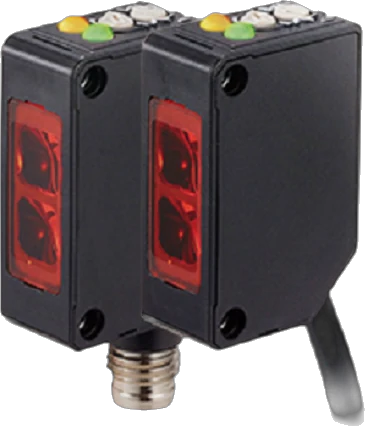
Missed detections and false triggers stop lines. The usual culprits: transparent or shiny products, dark objects on dark belts, small parts, dust, steam, washdown and ambient light.
Types of photoelectric sensors
Through-beam
Separate emitter and receiver. Longest range and the most reliable detection, even with dirt in the beam.
Models: V2 Series (70 m) · V3 / V4 Series · Z3 Series
Retro-reflective & transparent objects
Emitter and receiver in one housing with a reflector opposite. Coaxial optics remove the dead zone and detect clear bottles and film.
Models: ZR-X · Z3R-Q / ZR-QX (transparent objects)
Diffuse & background suppression
Detect the object itself with no reflector. Background suppression ignores whatever is behind the object. Ideal for dark, shiny or multicoloured products.
Models: BGS-Z · BGS-ZL · BGS-ZM · BGS-2V · BGS-HL/HDL
Fiber optic
Tiny fiber heads fit into tight spaces, high temperatures and fast processes; the amplifier sits safely in the panel.
Models: D1RF · D2RF · D3RF · BRF amplifiers · NF fibers · Telco MPA41 / MPA81
Laser & colour mark
A small, visible spot for small parts and precise positioning; colour mark sensors read registration marks on film.
Models: DSTA laser · DM 18 colour mark
Harsh environment
Rugged Telco sensors and remote sensor heads with separate amplifiers for demanding conditions.
Models: SM 3000 · SM 6000 · SM 8000 · LT / LR with PA10 / PA11 amplifiers
What to specify
| Parameter | What to check |
|---|---|
| Sensing distance | Through-beam reaches furthest (up to 70 m), retro-reflective next, diffuse shortest. Allow margin for dirt and ageing. |
| The object | Transparent → coaxial retro-reflective. Dark, glossy or varying colours → background suppression. Very small or in a tight space → fiber optic or laser. |
| The background | If a conveyor, machine frame or wall sits behind the object, use background suppression so it isn't detected. |
| Environment | Water, oil, dust and washdown call for higher protection (e.g. BGS-ZM is water and oil resistant) or remote sensor heads. |
| Response time | Fast lines need fast sensors. Fiber amplifiers such as the D3RF are built for high-speed response. |
| Output & connection | NPN or PNP to suit your PLC inputs; IO-Link (Z4 Series) for remote setup and diagnostics; M12 connector or cable; M18 threaded or rectangular housing. |
31 models in our range
Photoelectric sensors & amplifiers 31

Optex FA BGS-2V
Standard BGS model A renewal of the BGS-V series · Dual lens achieves long range detection…
View Details →
Optex FA BGS-HL/HDL
High resolution BGS laser sensor · Built-in controller and 4-digit display…
View Details →
Optex FA BGS-Z
3 models in the line-up to meet application · requirements…
View Details →
Optex FA BGS-ZL
Laser and high-power narrow beam LED sensors · Highly accurate height difference detection due to low hysteresis…
View Details →
Optex FA BGS-ZM
Excellent water resistance/ oil resistance · Suitable for automobiles, machine tools and food industry…
View Details →
Optex FA BRF
Easy sensitivity adjustments without the use of tools · Easy to turn sensitivity adjustment potentiometer…
View Details →
Optex FA D1RF
Intelligent & flexible · Teach-In + Display type…
View Details →
Optex FA D2RF
Fiber amplifiers featuring dual outputs, dual displays, and dual sensitivity correction functions · Enables detection for any application…
View Details →
Optex FA D3RF
Easy-to-use fiber amplifiers · Fastest high-speed response in the world…
View Details →
DM 18
Sensing distance # 18 ± 2 mm · Sopt Size # Approx. 1 × 6 mm at a distance of 18 mm…
View Details →
Optex FA DSTA
Water resistant sensor head usable even in water-splashing areas · Various sensor heads…
View Details →
LT / LR
Operation mode and max sensing range: · Thru-beam: Dependent on amplifier (up to 70m)…
View Details →
M18 - C2 Series
Standard M18 Threaded Type Sensor · Selectable metal or plastic enclosure…
View Details →
Telco MPA41
Multiplexed amplifier unit for fiber optic sensors. · Supports multiple sensor channels in one module.…
View Details →
Telco MPA81
Multiplexed amplifier for fiber optic sensors · Supports 8 sensor channels…
View Details →
Telco MPAE21
Operation mode and max sensing range · Thru-beam: 0-45 m…
View Details →
Optex FA NF
Type that can be mounted with a threaded nut Fiber units · Adjustable mounting type that switches between straight view and side view also available…
View Details →
Telco PA10
Operation mode and max sensing range · Thru-beam: 0-60 m…
View Details →
Telco PA11
Operation mode and max sensing range: · Thru-beam: 0-70 m…
View Details →
Telco PAB
Operation mode and max sensing range: Thru-beam: 0-70 m · Diffuse proximity: 0-4 m,…
View Details →
SM 3000
Max sensing range:Thru-beam: 1-15 m · Cable or plug connection…
View Details →SM 6000
Max sensing range: Thru-beam: 1-6 m · Cable or plug connection…
View Details →SM 8000
Operation mode and max sensing range: · >Thru-beam: 0-20 m…
View Details →
V Series
2 directional terminal block system useful for installation · Long range detection, 40 m through-beam brtype(universal voltage type)…
View Details →
V2 Series
Renewed V2 series with high-level specifications · 70 m sensing distance (through-beam type)…
View Details →
V3 / V4 Series
Universal voltage type that allows selection of connection types · Sensing distance: 70 m…
View Details →
Z2 Series
Cost effective and Eco-Friendly · Low price achieved by equipping our unique Opto-ASIC…
View Details →
Z3 Series
Industry standard sensor · Longest sensing distance in class at 25 m*…
View Details →
Z3R-Q/ZR-QX Series
Low cost type and coaxial type transparent object detection sensor · Long range detection at 2 m…
View Details →
Z4 Series
Industry standard sensors with IO-Link supported · Industry standard-sized amplifier built-in sensors…
View Details →
ZR-X Series
Coaxial optical system for stable detection · Zero detection dead area from a reflector…
View Details →Where they're used
Transparent bottles & film
Detect clear PET, glass and film reliably.
Conveyor presence & counting
Cartons, cases and products on the line.
Registration mark detection
Colour mark sensing for cutting and sealing on packaging film.
Small part detection
Fiber optics and laser for small or fast-moving parts.
Height & level differences
Background suppression for stack height and fill checks.
Machine tools & automotive
Oil- and coolant-resistant detection on the shop floor.
Common questions
Through-beam, retro-reflective or diffuse: which should I use?
Through-beam is the most reliable and has the longest range but needs wiring on both sides. Retro-reflective needs wiring on one side plus a reflector. Diffuse sensors need nothing opposite, but their range depends on the object's colour and surface, background suppression versions fix that by detecting only up to a set distance.
How do I detect transparent bottles or film?
Use a retro-reflective sensor designed for transparent objects, ideally with coaxial optics, such as the Optex FA Z3R-Q / ZR-QX series. It detects the small attenuation of light that a clear object causes.
What is background suppression (BGS)?
A diffuse sensor that measures by triangulation and switches only for objects closer than a set distance. Anything behind that point (a conveyor, machine frame or wall) is ignored, so dark and shiny objects are detected reliably.
When should I use fiber optic sensors?
When space is tight, the sensing point is hot or hard to reach, the parts are very small, or the process is very fast. Only the passive fiber head goes to the sensing point; the amplifier is mounted in the panel.
Do you have IO-Link photoelectric sensors?
Yes. the Optex FA Z4 Series supports IO-Link, which lets the PLC set parameters and read diagnostics and signal levels for easier setup and predictive maintenance.
NPN or PNP output?
Match your PLC input card: PNP (sourcing) sensors suit sinking inputs, NPN (sinking) sensors suit sourcing inputs. Tell us your PLC and we'll confirm the right output variant for the sensor you choose.
- Established
- 1994
- Quality system
- ISO 9001:2015
- Offices
- 8 across India
- Support
- In-house application engineers


Struggling with a tricky detection?
Tell us the object, distance, background and line speed. Our engineers will recommend the sensor type and model, and the mounting that makes it reliable.